
How to Get Rid of Bad Reviews on Google (What Actually Works)
Nobody enjoys finding a 1-star review on their Google Business Profile. Your stomach drops, you reread it three times, and the first thing you want is for it to disappear.
Sometimes it can. Often it can’t, at least not directly. But that doesn’t mean you’re stuck with the damage. Business owners who handle bad reviews on Google well usually come out with a stronger profile than before.
This guide covers how to get rid of bad reviews on Google in every way that’s legal and actually works: removing the ones that break the rules, resolving the ones you can fix, replying to the ones that stay, and outweighing them with real reviews. You’ll also see the shortcuts that can get your profile, or your business, into serious trouble.
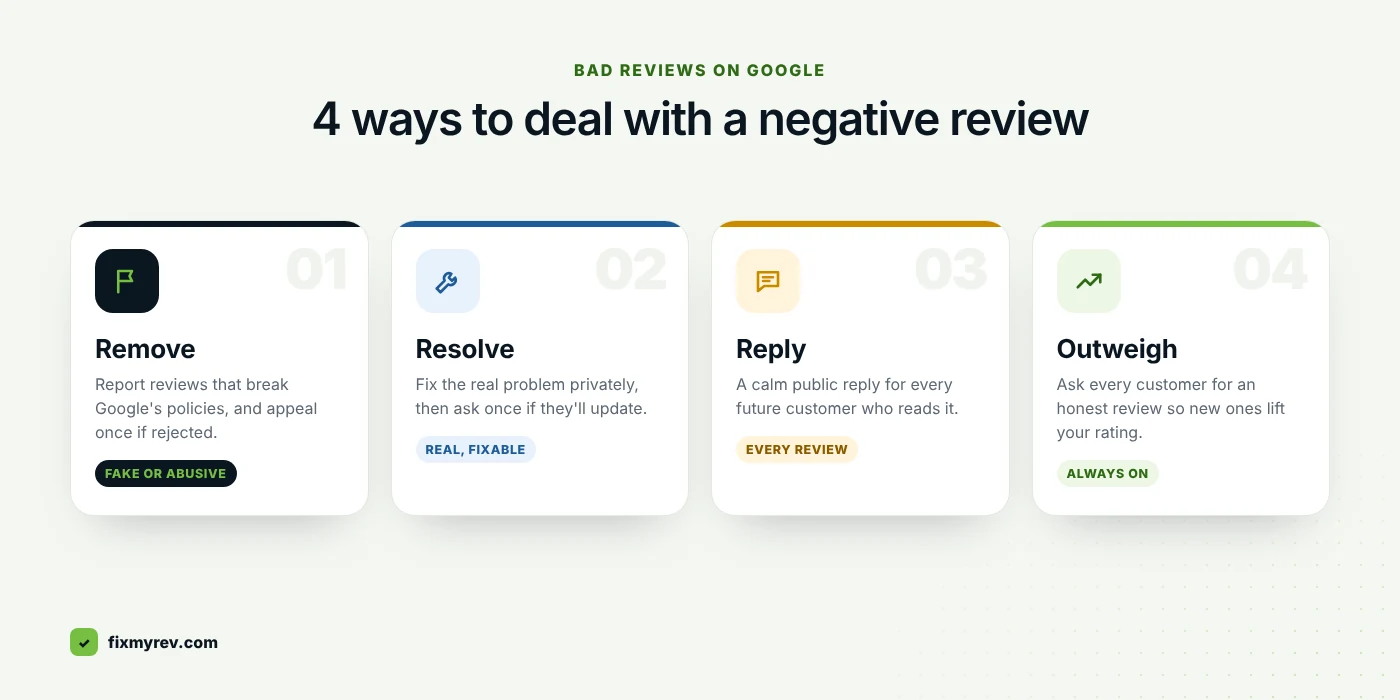
The 4 ways to get rid of bad reviews on Google
- Remove it, if it breaks Google’s policies: fake, off-topic, about a different business, abusive or sharing personal details. Report it and appeal if needed.
- Resolve it, if it’s a real customer with a fixable problem. Put it right, then they may choose to update their review.
- Reply to it, calmly and publicly, so future customers see a business that listens.
- Outweigh it, by asking every customer for an honest review. Fresh, genuine reviews push old negatives down and lift your rating.
Never buy reviews, offer incentives, only ask happy customers, or threaten a reviewer. All four break Google’s rules, and some are illegal in the US.
What to do in the first 24 hours
How you react in the first day matters more than most people realize. Before you try to get rid of negative reviews on Google, do these four things:
- 1Don’t reply straight away. An angry reply written in the moment is permanent, public, and often more damaging than the review itself. Give it a few hours.
- 2Screenshot it. Capture the review, the date, and the reviewer’s name and profile. Reviews can be edited, and you may need the original later.
- 3Check your records. Search bookings, invoices and messages for the customer. Talk to the staff who were working that day.
- 4Decide which kind of review it is, using the table below. That tells you which of the four ways to use.
Which kind of bad review is it?
The first step in how to get rid of bad reviews on Google is knowing what kind you’re dealing with, because not every negative review should be handled the same way. Reporting an honest review wastes your time. Replying to a fake one and moving on lets it sit there for good. Match the review to the right move:
| The review is… | Typical signs | Best move |
|---|---|---|
| About a different business | Mentions a product, service or location you don’t have | Remove |
| Fake or part of a wave | Several 1-stars in a few days, similar wording, new or empty accounts | Remove |
| Reacting to news or social media | Mentions a viral post or news story, not a visit | Remove |
| From an ex-employee or competitor | Inside knowledge, attacks on management, or a rival’s name | Remove |
| Abusive or sharing personal details | Threats, slurs, phone numbers, health details | Remove |
| A real customer with a fixable problem | Clear complaint about something you can put right | Resolve + Reply |
| Fair criticism | Honest, even harsh, about a real experience | Reply + Outweigh |
| Old and no longer true | About a problem you fixed long ago | Reply + Outweigh |
Way 1: Remove bad reviews that break Google’s rules
Google will take a review down if it breaks its content policies. You report it, Google evaluates it, and if Google says no, you get one appeal. We’ve covered every click of that process in our guide on how to remove a Google review, so here’s the part most guides skip: which reports tend to succeed.
Reports that tend to work
- Clearly the wrong business. The review complains about a product you don’t sell or a branch you don’t have. Google’s policy requires content to “accurately represent the location or product in question”.
- Written about someone else’s experience. Google asks for content based on your experience. “My friend went there and said it was awful” doesn’t qualify.
- Reactions to a news story or viral post. These aren’t based on a real visit. Report them together so Google sees the pattern.
- Conflict of interest. Current or former employees, or competitors posting about your business.
- Harassment, hate or personal information. Threats, slurs, or someone’s phone number or health details.
Reports that usually fail
- “This isn’t true.” Google says it won’t settle disputes between a business and a reviewer. Disagreeing with the facts isn’t enough.
- “We have no record of this person” on its own. Google accounts don’t have to use real names, so a missing match isn’t proof by itself. Pair it with other signals, such as wrong details, a wave of similar reviews or a suspicious reviewer history.
- “It’s unfair” or “it’s hurting our business”. True, but not a policy.
Dealing with a wave of fake 1-stars? That’s where removal matters most. See how we handle fake Google review removal, or remove negative Google reviews that cross the line.
Way 2: Resolve the problem behind the review
Many negative reviews on Google come from real customers who had a real problem. In that case, the best way to get rid of a bad review is often to fix what caused it. A customer who feels heard is far more likely to soften their review, or even turn it into a positive one.
- Reach out privately if you can identify them: phone, email or the details on their booking.
- Listen before you explain. Let them say their piece without defending yourself.
- Offer a fair fix: a redo, a replacement, an apology from the right person.
- Only then, and only once, ask if they’d consider updating their review.
The fix can’t depend on the review. Google strictly prohibits offering anything in exchange for changing or removing a review. Solve the problem because it’s the right thing to do, then ask, with no strings attached.
Way 3: Reply to bad reviews the right way
You can’t always get rid of negative reviews on Google, but you can control what sits directly underneath them. Your reply isn’t really for the reviewer. It’s for the dozens of potential customers who will read both. Google itself notes that helpful replies can help a business stand out.
A good reply is short, calm and specific. Thank them, own what’s yours to own, and move the conversation offline. Pick the situation that matches your review:
Reply template
Hi [Name], thank you for telling us about this, and we’re sorry we let you down with [specific issue]. That’s not the experience we want anyone to have. We’ve already [what you changed]. We’d love the chance to make it up to you, so please get in touch at [email or phone] and ask for [name].
Why it works: it names the problem, shows what changed, and gives a real person to contact.
Reply mistakes that make things worse
- Arguing about the details, or calling the reviewer a liar in public.
- Sharing the customer’s personal or booking information in your reply.
- Copy-pasting the same generic reply under every review.
- Replying to a likely fake review as if it were real and then never reporting it. Do both.
Way 4: Outweigh bad reviews with real ones
This is the slowest of the four ways to get rid of bad reviews, and the most powerful. When customers see one bad review among dozens of recent good ones, it reads as a bad day, not a bad business. And because many customers sort reviews by newest, a steady flow of fresh reviews means an old negative is rarely the first thing they see.
The catch is that the math is harsher than most owners expect. Here’s how many new 5-star reviews it takes just to cancel out one 1-star review:
| Your current rating | New 5-star reviews to cancel one 1-star |
|---|---|
| 4.0 ★ | 3 |
| 4.3 ★ | 5 |
| 4.5 ★ | 7 |
| 4.7 ★ | 13 |
| 4.8 ★ | 19 |
| 4.9 ★ | 39 |
The better your rating, the more a single bad review costs you. That’s why the strongest profiles combine removal of fake reviews with a habit of asking every customer for a review.
How to ask for reviews without breaking the rules
- Ask everyone, not just the customers you think are happy. Google’s policies forbid selectively asking for positive reviews.
- Make it one tap. Google lets you share a review link or QR code from your Business Profile. Put it on receipts, follow-up emails and texts.
- Ask at the right moment, right after a job well done, not weeks later.
- Never offer anything for a review: no discounts, freebies or entries into a prize draw.
If you’d rather not build this yourself, we help businesses get more Google reviews through simple SMS and email requests sent to every customer.
Your 30-day bad review recovery plan
Put the four ways together and you get a simple plan for dealing with bad reviews on Google. Most businesses can do this alongside their normal work.
Day 1–2Triage
Screenshot everything, check your records, sort each bad review using the table above.
Day 2–3Report & reply
Report every review that breaks a policy. Post calm replies to the honest ones.
Week 1Resolve
Contact the real customers you can reach. Fix what you can, then ask once.
Week 2Follow up
Check report status. Appeal any rejected reports with stronger evidence.
Weeks 2–4Outweigh
Start asking every customer for a review, every day, with a one-tap link.
OngoingMonitor
Check new reviews weekly so you catch the next fake one early.
What never to do (even when you’re tempted)
When a bad review is hurting sales and you want to get rid of bad reviews fast, shortcuts look attractive. These ones backfire, and some can land you in legal trouble.
- Buying reviews. In the US, the FTC’s rule on fake reviews has applied since October 21, 2024. It bans buying fake reviews and allows civil penalties against businesses that knowingly break it. Google removes them too.
- Threatening the reviewer. The same FTC rule bans “review suppression”, meaning baseless legal threats or intimidation used to get negative reviews taken down.
- Review gating. Sending only happy customers to Google and steering unhappy ones elsewhere breaks Google’s policies.
- Reviewing yourself, or asking staff to. That’s a conflict of interest under Google’s rules, and undisclosed insider reviews are covered by the FTC rule too.
- Mass-flagging with friends’ accounts. Google judges the review against its policies, not the number of reports.
- Paying anyone who “guarantees” removal. Only Google decides. Firms using fake legal notices or hacks can put your whole profile at risk.
Need help getting rid of bad reviews?
If fake reviews keep coming, a report was rejected, or you simply don’t have time to manage your profile, we can help, honestly and only through Google’s official process.
- Free, review-by-review audit within 24 hours
- We report and appeal the reviews that break Google’s rules
- We help you earn real reviews and protect your rating long term
When it’s time to get help
You can handle the occasional bad review on your own with the steps above. It’s worth bringing in a specialist when:
- Several negative reviews arrive in a short time, which often signals a coordinated attack.
- Google has already rejected your report and you only have one appeal left.
- You manage multiple locations and can’t keep up with new reviews.
- Your rating has dropped below a competitor’s and it’s costing you calls.
Our online reputation management service covers monitoring, reply writing and monthly reports, so bad reviews on Google get handled before they spread.
Frequently asked questions
Can I delete bad reviews on my Google Business Profile?
Not yourself. You can report reviews that break Google’s policies, and Google decides whether to remove them. Only the reviewer can delete their own review. For honest reviews, replying and earning new reviews are your best tools.
What’s the fastest way to get rid of bad reviews on Google?
If the review breaks a Google policy, reporting it is the fastest route, since Google typically decides within several days. If it’s an honest review, the fastest fix is a calm public reply today, followed by asking every customer for a review so newer, positive ones outweigh it.
How long does it take to get rid of negative reviews on Google?
Google says reported reviews typically take several days to evaluate, and appeals take longer. Outweighing a bad review with new ones takes weeks to months, depending on how many customers you serve and how consistently you ask.
Should I reply to a fake review?
Yes, briefly, and report it too. A short, polite reply such as “We can’t find any record of your visit; please contact us so we can look into it” shows readers you take reviews seriously, without arguing. Then report the review so Google can remove it.
Can I offer a refund if a customer removes their review?
No. Google strictly prohibits offering anything in exchange for changing or removing a review. You can refund or fix a problem because it’s fair, and you can ask once whether they’d update their review, but the two can’t be linked.
Does replying to bad reviews help my Google ranking?
Google says more reviews and positive ratings can help a business’s local ranking, and that helpful replies can help a business stand out. Replies mostly help by persuading the people reading them to choose you.
Is it legal to pay a company to remove bad reviews?
Paying for help to report reviews through Google’s official process is fine. What crosses the line is suppression: fake legal notices, threats, or tricks to hide honest reviews. In the US, the FTC’s rule specifically bans review suppression through baseless threats or intimidation.
The bottom line
Knowing how to get rid of bad reviews on Google isn’t about making every one disappear. You won’t get rid of every bad review on Google, and you don’t need to. Remove the ones that break the rules, resolve what you can, reply to the rest like a professional, and keep fresh, genuine reviews coming in. Do that consistently and one bad review stops being a crisis.
Not sure which of your reviews can go? Send them to us for a free, honest audit.
Sources
- Prohibited and restricted content, Google Maps User Contributed Content Policy
- Tips to get more reviews, Google Business Profile Help
- Report inappropriate reviews on your Business Profile, Google Business Profile Help
- How Google determines local ranking, Google Business Profile Help
- FTC announces final rule banning fake reviews and testimonials, Federal Trade Commission